

A short primer on economics for teenagers who want to learn the ingredients of strong economies. The reader will learn what makes nations prosper. The book will also help your teen learn how to become prosperous. (The economists share principles of personal finance.)
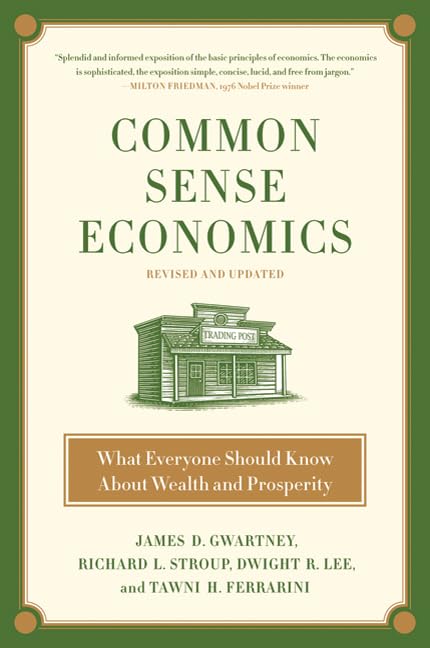
Significantly, the book explains the architecture of an economy, including its essential building blocks: the legal system, markets, and government regulations. The reader begins to understand why private property, contracts, and just (and limited) governments are critical to the wealth of nations and people.
Lastly, the book will help your child think more intelligently about economics and identify good versus bad economic policy. It’s also an opportunity for parents to help their children absorb personal wealth-building practices, which are explained at the end of the book.
“Profit is a reward for transforming resources into something of greater value.” (18)
“Trade depends on property rights, and a legal system must protect property rights if an economy is to prosper.” (38)
“Exchange is productive; it helps us get more from the available resources. Regulatory policies that force traders to pass through various political roadblocks are almost always counterproductive. A country cannot realize its full potential unless restrictions that limit trade and increase the cost of doing business are kept to a minimum. The market is the best regulator.” (51)
“The deficits are a natural outgrowth of unrestrained democratic politics. If unconstrained by constitutional rules or strong convictions, politicians will use deficits to partially conceal the cost of their programs from voters.” (93)
“Finding the occupational or business activity in which you have a comparative advantage and specializing in it will help you earn more money than otherwise….” (127)
Leave a reply. Keep it clean.