
Fill the Stage

Daniel Dignan

Fill The Stage

Helping students live well

new / index / about

YouTube


terms / privacy

Subscribe via Email

George Washington’s Newburgh Address

August 22, 2026 by Daniel Dignan Leave a Comment

At the end of the American War for Independence, Continental soldiers and officers nearly mutinied against General George Washington and Congress. For eight years, Congress had been unable to adequately provide provisions and pay, and the men feared they would never be paid. However, if the military rebelled, Washington knew it would risk their victory, tarnish their country’s reputation, and subvert their hard-won liberty under military tyranny. So Washington announced what James Thomas Flexner (his great biographer) considered to be the most important meeting ever called in American history.

In 1783, near the Continental military headquarters in Newburgh, New York, Washington delivered an address to a room full of his officers. He communicated the danger and consequences of mutiny, the need to maintain dignity and honor, and encouraged them to trust that their country and leaders would repay their sacrifice.

Then, in conclusion, Washington did and said something that shocked his officers, turning them away from certain doom and making them repent of their rebellion.

Read Washington’s Newburgh Address here and learn what happened. (It’s a five-to-eight-minute read.)

Filed Under: Civic Responsibility Tagged With: George Washington, Newburgh Address

George Washington’s Farewell Address

August 20, 2026 by Daniel Dignan Leave a Comment

Essential to the founding and rise of the United States, George Washington became known as the “Father of His Country.” Toward the end of his presidency in 1796, Washington published a farewell address, offering his gratitude and counsel to the people he served. It’s considered one of the greatest addresses in American history and is still read aloud in Congress.

President Washington warned of political factions and foreign entanglements. He encouraged religion and morality, calling them “indispensable supports” of “political prosperity” and “pillars of human happiness.” And he cautioned against the notion that morality could be enjoyed without religion.

The address is worthy of several reads.

House of Representatives reading:

Senate reading:

Filed Under: Civic Responsibility Tagged With: Farewell Address, George Washington

George Washington’s Speeches

August 13, 2026 by Daniel Dignan Leave a Comment

George Washington’s best speeches are a must-read for students interested in identifying their duty to their neighbors and country.

Hillsdale College provides a short summary of five of Washington’s greatest speeches.

George Washington, 1795, by Gilbert Stuart

Filed Under: Civic Responsibility Tagged With: George Washington, speeches

Cosco’s Millionaire Employees

August 8, 2026 by Daniel Dignan Leave a Comment

Cosco’s jobs and benefits offer opportunities for personal growth and upward economic mobility.

Filed Under: Earning a Living Tagged With: Cosco, employees, jobs

Frankenstein

August 3, 2026 by Josh Grover Leave a Comment

Our choices reach beyond the present moment and seize more than just ourselves. Such is the significant lesson taught in the classic story of Mary Shelley’s Frankenstein.

Shelley woos the reader’s attention and compellingly welcomes all into the world she creates through her vivid narrative, gripping plot, and memorable themes. The novel offers a powerful storyline that captures the dangers of obsession, unwillingness to act when evil first presents itself, the need for ethical input to direct the power of science, and the cost of losing the beauty of family and the enjoyment of life’s simple pleasures through a single act of self-centeredness.

My copy has a little more than 200 pages, which I completed in four hours, and every minute was well spent. I believe it will be the same for you. 

Filed Under: Personal Growth Tagged With: Frankenstein, Mary Shelley

Minor Prophets

July 23, 2026 by Daniel Dignan Leave a Comment

Gaspard Dughet – Seascape with Jonah and the Whale c. 1653-4

After Moses led Israel out of Egypt, God made a covenant (serious agreement) with Israel. (The Old Testament books of Exodus and Deuteronomy document the deal.) If the Israelites loved God with everything they had and treated their neighbors justly, God would bless them and make them a light to the nations. If they broke the terms of the covenant and did not change their ways, they would be cursed. (See Deuteronomy 28.)

The Old Testament histories, including Samuel, Kings, and Chronicles, detail the choices, actions, golden age (King David and King Solomon), successes, and, mostly, failures to keep the covenant, and the attendant consequences.

The prophets call Israel back to their covenant, indict them for their crimes, warn them of God’s judgment, plead with them to change their ways, and provide hope of God’s future mercy.

The prophetic books are divided into major and minor ones. Major prophets like Isaiah, Jeremiah, and Daniel are long works. The Twelve Minor Prophets (e.g., Jonah) are relatively short.

They reveal God’s sovereignty over the nations, His love for humanity and concern for justice, the horrors of idolatry, and God’s salvation plan through His Messiah and King, whom the New Testament identifies as Jesus of Nazareth.

Middle school or high school students who’ve read Genesis, Exodus, Deuteronomy, Samuel, Isaiah, and Jeremiah are well-positioned to enjoy and learn from the Minor Prophets. The message and literature move readers to consider what really matters.

For reading, I recommend the New Living Translation or the English Standard Version. For closer study, I recommend the New American Standard Bible (1995).

Filed Under: Personal Growth Tagged With: Bible, Jonah, Minor Prophets, Old Testament, Twelve Minor Prophets

Classical Education and The Homeschool

July 20, 2026 by Daniel Dignan Leave a Comment

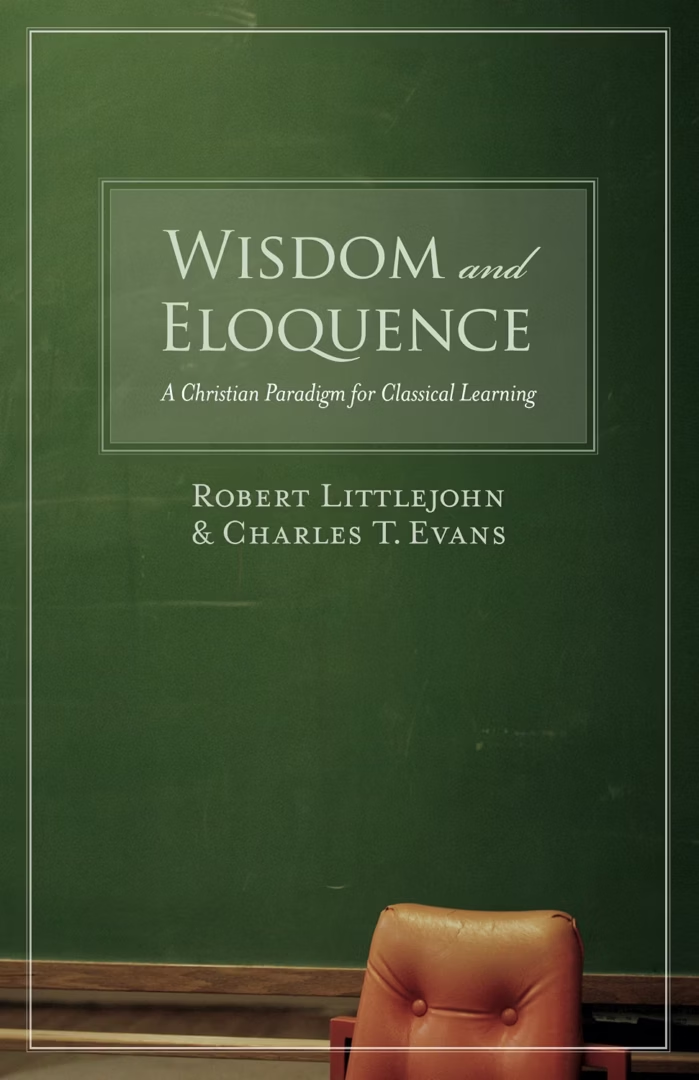
Have you ever wondered what classical Christian education is? This book is a very short primer for parents on the topic. The authors do a great job describing the basics of education and the importance of books, Latin, grammar, logic, and rhetoric.

The main idea is that education requires parental effort and intentionality. Not only must parents encourage their children to read great books, but they must also read them diligently for growth and instruction.

Parental effort and intentionality extend to nurturing character, wonder, imagination, respect, language, knowledge, argumentation, and communication.

Moreover, parents must diligently learn and teach the Christian worldview and help their students love God with everything they have, including their minds. This requires recognizing that God is sovereign over all things.

Finally, the authors recommend books for parental and student education.

Filed Under: Personal Growth Tagged With: Classical education, classical homeschool

The Case for Great Books

July 13, 2026 by Daniel Dignan Leave a Comment

Filed Under: Personal Growth Tagged With: Great books

Young Washington

July 9, 2026 by Daniel Dignan Leave a Comment

Over the weekend, I watched Young Washington in a local theater. I really enjoyed it. The movie largely followed the definitive biography by James Thomas Flexner on George Washington’s early years and exploits.

Recommend for high school students: young Washington’s quest for character, self-education, leadership roles, and courage under fire is compellingly displayed.

Young Washington had many exploits, including surveying dangerous wilderness, undertaking a long, treacherous diplomatic and spy mission for England’s King, and leading soldiers in war at Fort Necessity and during the French and Indian War, where he saved many lives during a defensive retreat. All by the age of 22.

Biographer James Thomas Flexner endeavored to set aside all presuppositions and contemporary views about Washington’s greatness and to let primary sources inform his writing, analysis, and conclusions.

Five books later — considered by one presidential biography reviewer to be the gold standard of presidential biographies — Flexner judged Washington to be truly great.

Washington’s countrymen, both common and elite, were in awe of his character and abilities. During America’s War for Independence, when told that Washington planned to return home and not seek political office, King George III said, “If he does that, he will be the greatest man in the world.”

Using Flexner’s account, here’s the story of a 21-year-old Washington’s hazardous diplomatic mission through the Ohio River Valley. (Young Washington, the movie, shows Washington’s standoff with the French, but does not quite capture the difficulty of the journey there and back to Virginia; it also skips a near-fatal encounter with an Indian guide.)

Filed Under: Personal Growth Tagged With: George Washington, James Thomas Flexner, The Forge of Experience, Young Washington

Jeremiah

July 6, 2026 by Daniel Dignan Leave a Comment

Jeremiah Lamenting the Destruction of Jerusalem, Rembrandt

Jeremiah, one of the Bible’s major prophetic works, foretold Jerusalem’s doom and destruction at the hands of Babylon, the superpower of the 7th and 6th centuries BC. Eventually, Babylon broke through Jerusalem’s walls, captured the king, and razed the city. At the end of the book, the unthinkable happens: Babylon, the golden empire, falls. Overthrown by an alliance of kings and nations led by Cyrus the Great of Persia.

Throughout the book, God, through the prophet Jeremiah, warns Judah and Jerusalem to forsake their rebellion and idolatry, but they refuse. Instead, they continue worshipping and offering sacrifices to idols and pagan gods. Even sacrificing their children, something God said never came to his mind.

The book’s scenes do not all unfold chronologically; instead, like a Christopher Nolan film, we are made to experience different aspects of the relentless drumbeat toward Jerusalem’s fall. Pressure builds as kings come and go; Jeremiah is targeted and imprisoned, left to die, and eventually rescued; Judah’s young king secretly seeks his counsel.

One thing is sure: the Babylonians are coming. And when they do, they eventually surround and besiege Jerusalem’s wall for two years. Famine, overconfidence, and terror fill their sad days. The great Nebuchadnezzar tightens his grip.

Judah’s national nightmare comes true, but it also intensifies. After Jerusalem is destroyed, those who remain are put under a Jewish governor named Gedaliah, only to be assassinated by a Jewish royal official. The people beg Jeremiah to ask God what they should do, promising to do as God commands. But when he tells them that they must not go to Egypt but remain in Judah, or they will suffer further destruction. They refuse to listen. While in Egypt, Jeremiah confronts the Judeans about their idol worship, but they brazenly declare, “We will not listen to your message from the LORD! We will do whatever we want…” (Jeremiah 44:15-16, New Living Translation).

The key to the book is the LORD’s promise to restore Judah’s line of kings (which originated with the great king David) and his introduction of the new covenant (23:5-6; 31:31-34). (The old covenant is the one God made with Moses and the people of Israel at Mount Sinai (see Exodus) and reaffirmed in Deuteronomy. The people broke the terms by worshipping other gods and acting unjustly.)

The new covenant is fully revealed in the New Testament (meaning New Covenant) and established and ratified by Christ’s atoning work on the cross and resurrection from the dead. The benefits- forgiveness from sin, righteousness, and peace with God- are available to all who are connected to Jesus by faith and are part of his church. Moreover, Jesus is revealed to be the King of kings who restores the line of King David.

The book is dark and terrorifying, causing the reader to shake his head in dismay, gasp for breath, and feel the agony of the people’s self-harm. But Jeremiah contains rays of hope, ones that allude to God’s future mercy in the new covenant for Israel and the nations: “They will bind themselves to the LORD with an eternal covenant that will never be forgotten.” (50:5)

A serious read, Jeremiah reveals the consequences of putting one’s trust in human beings and false gods, the blessings for those who put their trust in Jesus, and the deceitfulness of the human heart, which falls continually for idols that disappoint. (17:5-10).

Filed Under: Personal Growth Tagged With: Hebrew Bible, Jeremiah, Old Testament

  • 1
  • 2
  • 3
  • …
  • 15
  • Next Page »