

The Last Days of Socrates
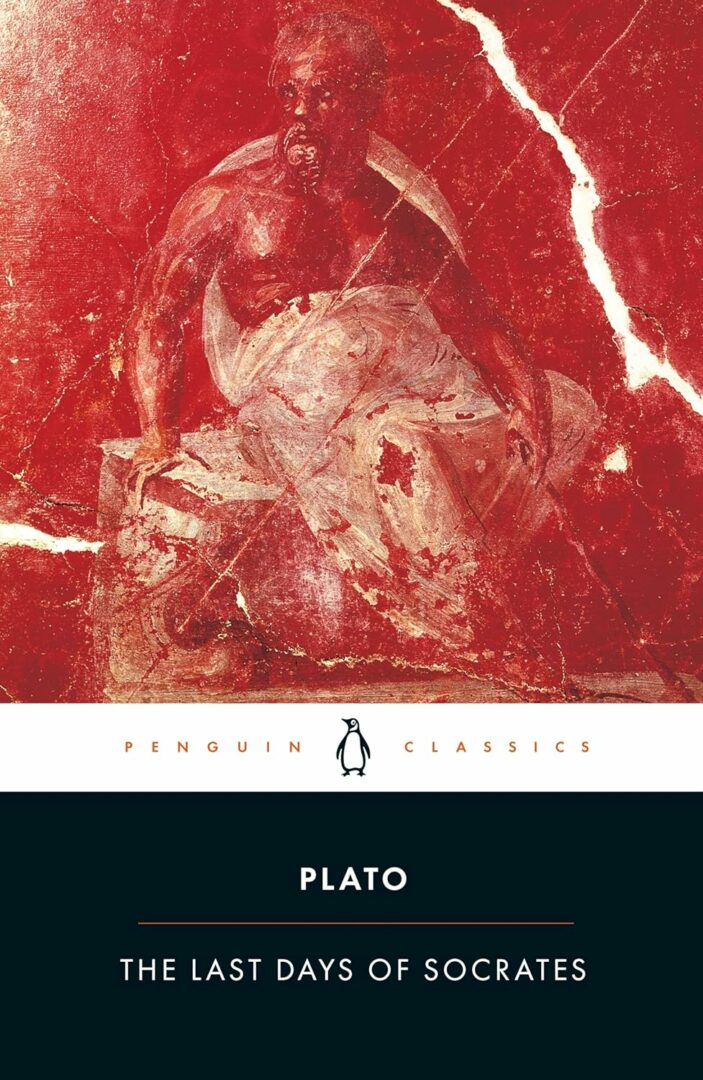
Socrates, the great ancient Greek philosopher who loved wisdom and strongly influenced Plato and Western Civilization, was accused of impiety and of corrupting the youth of Athens and was condemned to die.
Famed for his obsessive focus on wisdom, the good life, and the soul, he eschewed living merely for economic or material gain and believed that behaving wickedly is worse than dying.
At his trial, Socrates said: “But I suggest, gentlemen, that the difficulty is not so much to escape death; the real difficulty is to escape from wickedness, which is far more fleet of foot.”
Socrates believed human wisdom alone was insufficient for the good life, that wisdom requires being aware of one’s ignorance, and that the unexamined life was not worth living.
The Last Days of Socrates features four well-known dialogues attributed to Plato that take place during Socrates’ trial and death.
- Euthyphro: Socrates is on his way to court; he and Euthyphro discuss the nature of holiness or piety, which Socrates believes is a form of justice.
- Apology is Socrates’ trial defense before an Athenian jury. Certainly, the most famous and read of all the dialogues.
- Crito: A pupil and friend tries to persuade Socrates to escape from prison and execution. Socrates argues that escaping would be unjust, as it would overturn his city’s laws.
- Phaedo concerns Socrates about to die. Among friends, he seeks to prove the immortality of the soul.
These are not dry philosophical treatises; they are enjoyable, literary masterpieces that provoke serious thought about important questions.
Crito
Crito follows the Apology, Socrates’ trial defense. Wrongly accused of promoting bad religion and corrupting the youth of Athens, he was condemned to die. While in prison, Crito, his friend, tries to persuade Socrates to escape, arguing that anything less would be unjust.
Socrates argues that it would be unjust to disregard his city’s government and laws. Stating that the city’s legal regime gave him life (via marriage laws), education, and happiness, if there is no legal recourse, and if he is unsuccessful in persuading city officials, he must submit to the law.
He believes that any decision to escape would not only be unjust but would also cost him all credibility in a foreign land.
This guy explains Crito well.
In the Apology, Socrates admitted that if he were set free or banished, he would continue to have conversations with people about living well. The very conversations that led to his trial. Socrates was more concerned about doing what was right and just than what was politically correct. At the same time, if condemned, he would not seek to escape the city illegally.
Apology
Perhaps the most well-known of all the dialogues of the first great Greek philosopher.
Socrates has been accused of corrupting the youth with bad ideas and bad religion. In this dialogue (written by his most famous student, Plato), Socrates defends himself in court.
He argues that his marketplace conversations were intended to illuminate the path of wisdom and living well. He explains why the gods consider him wiser than others, and he endeavors to help his countrymen realize they are not living as wisely as they believe.
Far from corrupting the youth, he urged his countrymen to live for moral rather than practical gain, to examine what is best for the soul, and to be more concerned about what is just rather than how to prolong their lives.
Socrates argues that the gods considered him the wisest because he realized he was not. And that human wisdom is not sufficient for living well. He angered his fellow citizens by revealing their lack of wisdom.
A high school student (10th grade +) can read this dialogue in one or two sittings. This dialogue can be read many times, enjoyably and helpfully.
Socrates was the first great Greek philosopher. He pursued wisdom, endeavored to answer life’s big questions, and showed others how to live wisely. His most famous pupil, Plato, recorded his final days in dialogues such as Euthyphro, Apology, and Crito.
Euthyphro
Socrates, Plato, and Aristotle (the three great Greek philosophers of antiquity) investigated life’s big questions: What is real? (Metaphysics) How do we know what we know? (Epistemology) And how should we live? (Ethics)
They believed in the objectivity of truth and sought to understand how to live the good life.
In The Dialogues, Plato, Socrates’ student, recorded Socrates’ thinking and beliefs. They are quite entertaining and thought-provoking, and they increase understanding of ideas through intensive questioning, which became known as Socratic questioning.
One dialogue is titled Euthyphro. In it, Socrates and his friend Euthyphro strike up a conversation (while on their way to court) about the nature of piety (i.e., holiness or the good). Socrates asked what it is and how it relates to justice.
After much back and forth, Socrates asked a famous question, known as Euthyphro’s dilemma: Do the gods love something because it is good, or is something good because the gods love it?
The question deals with the nature of God and what it means to live the good life.
I recommend the translation by Benjamin Jowett. (A high school student can read it in one hour. Skip the introduction.)
Finally, while thought-provoking, the dilemma is false. These Christian philosophers explain why: